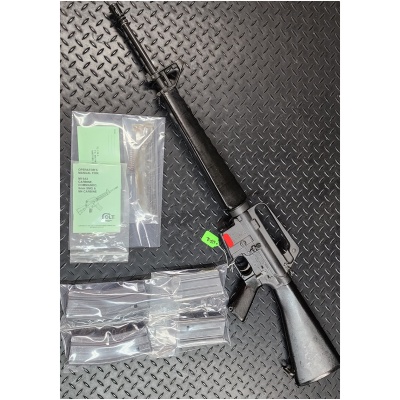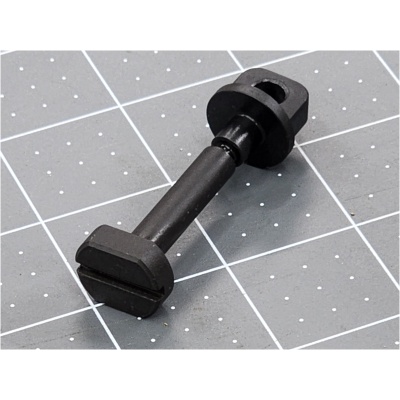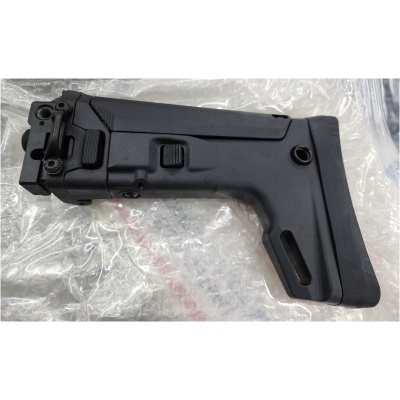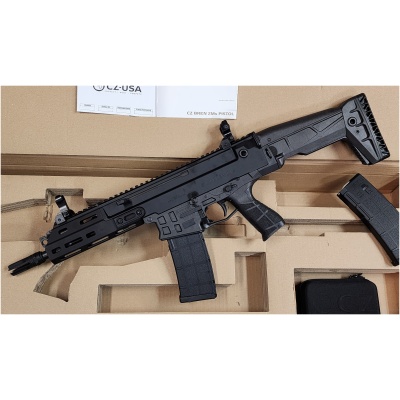
First of
all, check your state laws and verify that ownership and
possession is legal in your state.
Second,
find a qualified Class 3 dealer that handles transfer of
NFA weapons, he will prep the Forms for you. Once you
have verified ownership rights and located a dealer to
handle your transfer then you must decide how to take
ownership of the weapons. Federal and state laws allow
individuals and also corporations to own these weapons.
If you wish to purchase one as an individual you must
obtain a sign off on BATFE Form 4 from a Law Enforcement
Officer in charge as a Sheriff or Chief of Police in
whose jurisdiction you reside. If you cannot obtain
their signature you have another option if you are an
officer or director of a corporation. The corporation
can purchase the weapon without any law enforcement
signature, photos or finger print cards and usually
transfer time is reduced and the finger print cards
(none) don't need be sent to FBI for check.
The National Firearms Act of 1934 (NFA 34):
This law placed certain classes of firearms into a
registered ownership category. Private individuals can
possess a functional machine gun, silencer (suppressor),
short-barreled rifle or shotgun, smooth-bore pistol,
cane gun, or destructive device (certain shotguns,
grenade launchers, hand grenades, bazookas, mortars,
cannon, etc.) only after first paying a Federal Transfer
Tax of either $5 or $200 per firearm/device. The $5 tax
applies to pen guns, cane guns, smoothbore pistols, or
any other such firearm that the Bureau of Alcohol,
Tobacco and Firearms classifies as "Any Other Weapon" (AOW).
All other functional guns or devices in the NFA registry
require payment of a $200 federal tax for each private
transfer. The tax is not an annual tax. It only is
paid each time a functional NFA firearm is being
transferred to or from a private owner (excepting
inheritance).
The Gun
Control Act of 1968 (GCA 68): Largely
modeled after the 1938 Gun Control Act of Nazi Germany,
a section of this law updated the NFA 34 by restricting
the transfer of newly imported machine guns to the
military, law enforcement, and certain Special
Occupational Tax (SOT) payers. In addition, a short
moratorium was provided before the law went into effect,
to allow unregistered machine guns and other NFA
firearms already in private hands, to be added to the
Federal Registry without penalty.
The Gun Owners Protection Act of 1986 (GOPA 86):
A somewhat vague statement was added to this
bill that has been interpreted by the Bureau of Alcohol,
Tobacco and Firearms (BATF) and some Federal Courts to
mean no machine guns registered after enactment (May 19,
1986) can be built and sold to private individuals.
BATF further concluded that SOT payers cannot receive
"post-May" guns without first presenting a letter from
a qualifying government agency that has requested to see
the firearm. These rulings do not apply to other types
of NFA firearms. Transfers to government agencies
having law enforcement or military functions are
allowed. SOT payers who are also licensed as
manufacturers are allowed to produce machine guns from
scratch, from kits, or by means of conversion. They
cannot transfer them to private individuals. They can
be transferred to other SOT payers or government
agencies only as described above. Post-May guns cannot
be retained by a SOT payer who fails to renew his SOT
annually.
THIS BAN SUNSET IN SEPT/04, UNFORTUNATELY STILL GOOD FOR
A FEW STATE
The
Violent Crime Control and Law Enforcement Act of 1994 (VCCLEA
94): This law banned the public sale of new
detachable magazines with more than a ten round
capacity, and invented a new term - assault weapon, the
future manufacture of which were also banned from public
sale. Note, the law applies only to firearms
manufactured after enactment of the law. Specifically,
it limits certain features on certain types of
firearms. Semiautomatic rifles with detachable
magazines may possess no more than one of the following
features: pistol grip protruding conspicuously beneath
the action, telescoping or folding stock, threaded
barrel desinged to accommodate a flash suppressor, flash
suppressor (not to be confused with a muzzle brake),
grenade launcher, bayonet mount. Semiautomatic pistols
with detachable magazines may possess no more than one
of the following features: magazine that attaches
outsidethe pistol grip, threaded barrel, shrouded
barrel, unloaded weight of 50 ounces or more, a
semiautomatic version of an automatic firearm.
Semiautomatic shotguns may possess no more than one of
the following features: folding or telescoping stock,
pistol grip that protrudes conspicuously below the
action, fixed magazine capacity over five rounds,
ability to accept detachable magazines.
State
Laws and Local Ordinances: Most states
allow ownership of NFA firearms, but some states or
local municipalities have statutes or ordinances that
restrict or ban ownership. At last count thirteen
states placed some sort of restrictions on the types of
NFA firearms you could own (anything from requiring a
state permit to outright denial). These include
California, Hawaii, Illinois, Iowa, Kansas, Maine,
Michigan, Mississippi, Missouri, New Jersey, New York,
and Rhode Island. If you are uncertain of the laws in
your area, contact your state or national gun rights
organization for help. They likely will know more about
your local firearms laws than anybody else.
Where to
find NFA Firearms: A private citizen can
acquire NFA firearms from other private individuals or
dealers in his own state so long as there are no state
laws restricting ownership. Most states allow private
ownership (39 at our last count), but if you have any
questions, e-mail us and we'll let you know. Regular
gun dealers, SOT payers, military organizations, and law
enforcement agencies can acquire NFA firearms from
sources in any state, i.e., manufacturers, dealers,
private collectors, or government agencies. Confiscated
firearms may be retained or acquired by government
agencies, with BATF approval.
Private Transfers:
A private citizen can acquire functional NFA firearms
from private collections in his own state, provided he
first pays the applicable NFA transfer tax on each
firearm and receives BATF approval. If he is receiving
any firearm as part of an inheritance, the tax can be
waived but the paperwork first must be approved before
receiving the firearm. If the firearm is nonfunctional
and registered as a DEWAT (deactivated war trophy), the
tax is not due but the federal paperwork still must be
filed and approved before taking receipt of the NFA
firearm.
Government Agency Transfers: There are no
federal prohibitions on any type of government entity
acquiring most NFA firearms, including many destructive
devices. Some states prohibit law enforcement agencies
from possessing certain types of NFA firearms or
destructive devices. Government agencies are exempt
from paying Federal Transfer Taxes or Federal Excise
Taxes. In most cases, machine guns and other NFA
weapons can be imported, purchased off-the-shelf, or
custom manufactured specifically for any authorized
government agency. Excluding direct military contracts
with licensed manufacturers, all other transfers to
government agencies, including law enforcement agencies,
must first be approved by BATF. All foreign transfers
require State Department approval.
SOT
Dealer Transfers: The SOT (Special
Occupational Tax) is an annual fee paid to the U.S.
Treasury Department by dealers, manufacturers, or
importers of certain products including alcohol,
tobacco, and firearms. In the case of firearms, the SOT
is broken down between NFA dealers, manufacturers, and
importers (A separate SOT applies to destructive
devices). For our purposes the term "SOT payer" refers
to any currently licensed gun dealer, manufacturer, or
importer who also has paid the SOT for dealing in NFA
firearms. SOT payers have the advantage of being able
to transfer functional NFA firearms to or from other SOT
payers and government agencies, with BATF approval, but
without having to pay a transfer tax. SOT payers also
can acquire registered NFA firearms from any regular gun
dealer or private citizen, but only after paying the
applicable transfer tax and receiving BATF approval.
SOT payers can transfer certain functional NFA firearms
to in-state residents and to both in-state and
out-of-state regular gun dealers, but only after they
have paid the appropriate transfer tax and received
approval from BATF.
Regular
Gun Dealer Transfers: Regular gun dealers
or manufacturers who do not have SOT's, still can
acquire functional NFA firearms from in-state or
out-of-state sources. If the firearm is a machine gun,
they are restricted to purchasing only those machine
guns registered prior to May 19, 1986, excluding all
dealer samples. The applicable NFA transfer taxes must
first be paid on each NFA firearm ordered. Once this
paperwork is approved and they have received shipment,
transfers can then be conducted with private individuals
in-state, or with other dealers either in-state or
out-of-state. These transfers also require payment of
the tax and BATF approval before they can be completed.
How to Pay the
Tax: If you are acquiring an NFA firearm
from a SOT payer, he will provide you with copies of the
required paperwork for each firearm being transferred to
you. If this is a private transfer or a transfer from a
regular gun dealer who does not possess a SOT, forms can
be acquired from the Bureau of Alcohol, Tobacco and
Firearms (BATF), National Firearms Act Branch,
Washington, D.C. Some states have their own
requirements in addition to the federal paperwork.
Check with the appropriate licensing bureau in your
state. The federal paperwork involves two forms that
are completed in duplicate (ATF Form 4 and fingerprint
card). The front of the ATF Form 4s are filled out and
signed by the seller (See exceptions for SOT payers and
corporations below). On the back of the Form 4s are
placed recent photographs of the purchaser. The
purchaser also signs the block under his photograph.
The bottom backside of the forms are endorsed by the
purchaser's sheriff, chief judge, police chief, etc.
The second set of forms are FBI fingerprint cards.
While the Form 4s are being endorsed, ask to be
fingerprinted using the cards supplied by BATF. Both
the person fingerprinted and the person taking them sign
these forms. The seller then mails the paperwork and a
check for the transfer tax to BATF. On average it takes
about 90 days for approval. The seller will receive
back one of the Form 4s with a Federal Transfer Tax
Stamp attached to it. This is given to the purchaser
when he picks up the NFA firearm. It's his firearm from
then on. No further tax is due.
Corporate
Ownership: In some areas it is difficult to
get a law enforcement signature on the ATF Form 4. To
circumvent this problem, some people purchase the gun
through a corporation. If you are a SOT payer acquiring
a firearm from a private source, or if you are a private
individual who is incorporated or is a senior officer in
a corporation, you can acquire an NFA firearm on an ATF
Form 4 without the need for a law enforcement
endorsement, photograph, or fingerprint card. You still
must pay the Federal Transfer Tax. If the gun is
transferred to a corporation, it must be retained by the
corporation until it is dissolved. At such time the gun
must be sold on a tax paid transfer, retitled to someone
on a tax paid transfer, or surrendered to the BATF.
Travel and Use:
Do not take NFA firearms out of state without first
checking with BATF. For machine guns, short barrel
rifles, and short barrel shotguns, you will need prior
approval from BATF on a Form 5320.20 to travel
interstate or to permanently move NFA firearms to
another state. This protects you from accidentally
going some place where they are banned. If the state
you are traveling to allows possession of the type of
NFA firearm you own, and you have received prior
approval on a Form 5320.20 (if applicable), then you can
transport the firearm through any state just like any
other firearm. That means it must be unloaded and
readily inaccessible (in a locked case or trunk of the
car). While in a travel status you are afforded the
same protection as any other gun owner under the GOPA 86
law. You cannot be legally arrested for simply passing
through a state, county, or township where the guns are
banned unless you violate the procedures just described
or stop in that state for an extended period of rest.
Necessary stops for food, gas, repairs, etc., are
allowed. Stopping to site-see, visit friends, or even
spend the night, might be construed as an unnecessary
delay and place you at risk. Check your state and local
laws for other restrictions that may apply regarding
hunting, concealed carry, or self-defense with an NFA
firearm.
Temporary
Transfers: NFA firearms may be left for
repair with an authorized person (dealer, gunsmith,
manufacuturer) without filing any federal paperwork
(check your state and local laws for any restrictions).
BATF advises owners to first file a Form 5 before
doing this. The Form 5 was designed for the purposes of
inheritance, government acquisition, or to transfer a
deactived firearm. It looks very similar to the Form
4, the main difference being that no tax is paid.
However, law enforcement endorsements and fingerprint
cards are required (unless waivedby BATF). As a result,
the Form 5 is a bit awkward for purposes of repair. If
you are taking the firearm to someone local and
reputable, and the repairs won't take a very long time,
then a Form 5 may seem pointless. If you are shipping
the firearm to someone you don't know, it might be best
to use the Form 5 as an audit trail. Indeed, some
companies won't accept NFA firearms without an approved
Form 5. Use your best judgement.
Transferable
Firearms: NFA firearms that can be
transferred to private citizens on an ATF Form 4 are the
most desirable, and therefore most expensive ones to
acquire. They are often referred to as "fully
transferable". Nearly all NFA suppressors, short
barrel rifles, short barrel shotguns, and AOWs are
transferable. The number of registered machine guns
that are transferable was frozen in 1986. Included in
this category are the following machine guns:
Original
or converted machine guns, whether foreign or domestic,
if added to the Federal Registry prior to enactment of
the GCA 68.
Deactivated war trophies (DEWAT) that were registered
prior to enactment of the GCA 68. DEWATs can be
reactivated after payment of the $200 Federal Transfer
Tax and approval by BATF.
Domestically manufactured or remanufactured guns that
were registered after the GCA 68 enactment, but prior to
the GOPA 86 (May 19th, 1986). This includes registered
receivers, sears, bolts, or other parts accepted by BATF.
Imported
guns that were remanufactured into machine guns prior to
the GOPA (May 19, 1986). This includes registered
receivers, sears, bolts, or other parts accepted by BATF.
Curios and Relics:
Some states allow private ownership of machine guns only
if they are listed as Curios & Relics by the Federal
Government. Examples would include original Thompson
1921 or 1928 submachine guns, and early production M-16
rifles. The Curios & Relics list is periodically
updated and you can petition for particular guns to be
added. Normally a gun is accepted to the list if the
Federal Government determines it is of some historic
value or of such an age or rarity that it is unlikely to
see criminal use. Collectors who possess a Curios &
Relics license (FFL) can purchase these guns
out-of-state, with prior payment of the applicable
transfer tax and approval by BATF.
Pre-May Dealer
Sample: Machine guns imported after 1968
and prior to May 19, 1986, are transferable to FFL
dealers (01) and manufacturers (07) who have paid the
Special Occupational Tax (SOT) for the current year. A
dealer who acquires a pre-May dealer sample and then
fails to pay the SOT in succeeding years may retain the
gun in his private collection. It only can be
transferred to someone holding a SOT or to an approved
government agency, usually military or law enforcement.
An exception is made sometimes if the gun is being
inherited from the dealer's estate by a family member.
Post-May
Dealer Sample: Any machine gun manufactured
or imported after May 19, 1986, can be transferred
between SOT payers only if they first provide a letter
on agency letterhead showing that a legitimate
government organization has requested to see it. This
usually means a law enforcement agency or military
unit. The gun can be retained by the
dealer/manufacturer only so long as he pays his annual
SOT. If he drops the SOT, BATF expects him to first
dispose of, surrender, or destroy the gun. It can be
transferred only to another SOT payer or approved
government agency, as previously described.
Privately Building NFA Firearms: Provided
there are no state or local restrictions, you can build
your own NFA firearm if you receive prior approval from
BATF on a tax paid Form 1. Along with the Form 1, you
must include fingerprint cards, law enforcement
endorsement, and a drawing of the firearm. Machine
guns will not be approved. Only suppressors, short
barrel shotguns, short barrel rifles, and AOWs will be
approved. In all cases, the tax will be $200 per
firearm. Once approved, they will be treated as any
other fully transferable NFA firearm.